
AI & APIs
Muse Wonder vs. Opus 5.5
Compare inputs, pricing, and public benchmarks, then evaluate Muse Wonder and Opus 5.5 with a repeatable task, shared criteria, and full cost accounting.

Muse Wonder and Claude Opus 5.5 are reasoning models for complex work. Meta develops the former and Anthropic the latter. Both can analyze material, help with code, and serve as the model inside an agent application.
Choosing between them is difficult because price lists, leaderboards, and actual work answer different questions. A price list gives a rate per token. A leaderboard reports performance on a set of tasks. Your product also has to account for input formats, waiting time, and human rework.
This comparison follows one incident ticket: check whether the material can reach the model, examine public results and costs, then design a small evaluation you can repeat. Sources and prices were checked on October 13, 2026.
This article reviews public evidence and proposes an evaluation method. Scores are attributed to their sources. Interface captures show preparation, rather than a completed comparison run by us.
1. Begin with one incident ticket
Suppose some Android users return to the login page after a release. You have a deployment timestamp, error logs, screenshots, and a short recording of the user’s actions. You want known facts, hypotheses to verify, and a useful investigation plan.
There are at least two questions here. Can the model understand the material? Once it does, are its recommendations supported by evidence?
Muse Wonder’s model card lists text, image, video, and audio inputs with text output. Opus 5.5’s public specifications list text and image inputs. Both have a context window of roughly one million tokens. Meta model card, Opus 5.5 specifications
For directly submitted video or audio, Wonder is therefore worth checking first. Meta also says audio availability must be confirmed on the particular service surface. An Opus workflow generally needs transcription or frame extraction for this material; record that work’s cost and potential information loss as well. Meta developer announcement
A large context window means there is room for more information. It does not guarantee that every relevant detail will be found. Incident analysis should still separate facts in the supplied evidence from guesses that require another check.
2. Confirm which version you are comparing
The comparison here is the ordinary API-accessible Muse Wonder against Claude Opus 5.5.
Meta also released Muse Wonder Full, currently available through particular Muse Code subscription plans. The ordinary model also has different identifiers on Meta’s API and OpenRouter. Official access announcement
| Service | Model name or ID | Role in this comparison |
|---|---|---|
| Meta Model API | muse-wonder-1.0 |
Official API for ordinary Wonder |
| OpenRouter | meta/muse-wonder |
Relay identifier for ordinary Wonder |
| Particular Muse Code subscriptions | Muse Wonder Full | A separate variant whose scores cannot replace ordinary Wonder’s |
| Claude API | claude-opus-5-5 |
Official API for Opus 5.5 |
Identifiers and access options are documented by Meta, OpenRouter, and Anthropic.
Also establish whether you are using a chat interface, a raw API, or an agent with tools. A model’s ability to request a tool does not mean that a chat endpoint executes commands, reads a repository, or maintains persistent memory for you.
3. Why matching rates produce different bills
Start with the published standard API base rates, in USD per million tokens.
| Category | Muse Wonder | Opus 5.5 |
|---|---|---|
| Uncached input | $4.00 | $4.00 |
| Cache read | $0.20 | $0.20 |
| Output | $20.00 | $20.00 |
These three rates match. Meta pricing, Anthropic pricing
With only 10,000 uncached input tokens and 2,000 billable output tokens, the base token charge is $0.08 for either model. This is arithmetic for fixed usage; an actual run need not produce identical usage.
Long tasks repeatedly submit context, may hit a cache, and may require retries. Reasoning, tool results, and final answers affect the bill. Tokenizers also differ, so identical text need not produce the same token count.
Anthropic separately prices cache writes at $5 per million tokens for five minutes and $8 for one hour. Its asynchronous Batch API discounts input and output by 50%. Meta’s announcement above does not list a corresponding batch discount. Fix the service mode when comparing costs instead of comparing one provider’s batch rate with another’s interactive rate. Anthropic billing documentation
Artificial Analysis reports an instructive combination: Wonder at max effort scores 52 on its Intelligence Index, with a weighted index cost per task of $4.52. Opus 5.5 at max effort with default fallback scores 58 and costs $5.98 per task. Wonder evaluation, Opus evaluation
Matching token rates, different overall scores, and different evaluation costs can all coexist. That cost per task is an index-weighted metric from this evaluator. It is not a quote for processing your incident ticket.
4. Read “five wins out of fourteen” as a clue
Counting the fourteen rows comparing ordinary Wonder and Opus 5.5 in Meta’s published scorecard gives five higher scores for Wonder and nine for Opus. That claim can be checked against the official table. Meta scorecard
Four rows illustrate how coding workloads differ. These are scores in Meta’s published table; higher is better.
| Evaluation | Ordinary Wonder | Opus 5.5 |
|---|---|---|
| DeepSWE 1.1 | 78.8 | 74.2 |
| SWE-Marathon | 53.1 | 46.3 |
| Terminal-Bench 4.0-AA | 52.0 | 59.6 |
| ProgramBench | 50.0 | 70.5 |
Source: Meta’s published results. The first two concern long-horizon software engineering; the latter two concern terminal tasks and reconstructing a complete program. They do not reduce neatly to one claim about being better at coding.
Footnotes matter. The model card attributes these models’ DeepSWE results to Datacurve. SWE-Marathon uses externally reported results and is not a controlled comparison with one common agent harness across the entire row. Some internally generated competitor runs are also described as best-effort configuration matches. Evaluation methods and limitations
Fourteen rows are not fourteen independent votes from your business. Composite indexes overlap with individual evaluations. Even Wonder’s GDP.pdf result of 30.8 against 30.6 lacks the uncertainty information needed to establish a reliable advantage. Use these figures to choose workloads worth investigating.
My recommendation is to establish an Opus 5.5 baseline for general coding and knowledge tasks, while including Wonder in evaluations of long-horizon engineering and native audio or video input. This is a judgment from public evidence; your acceptance results should decide deployment.
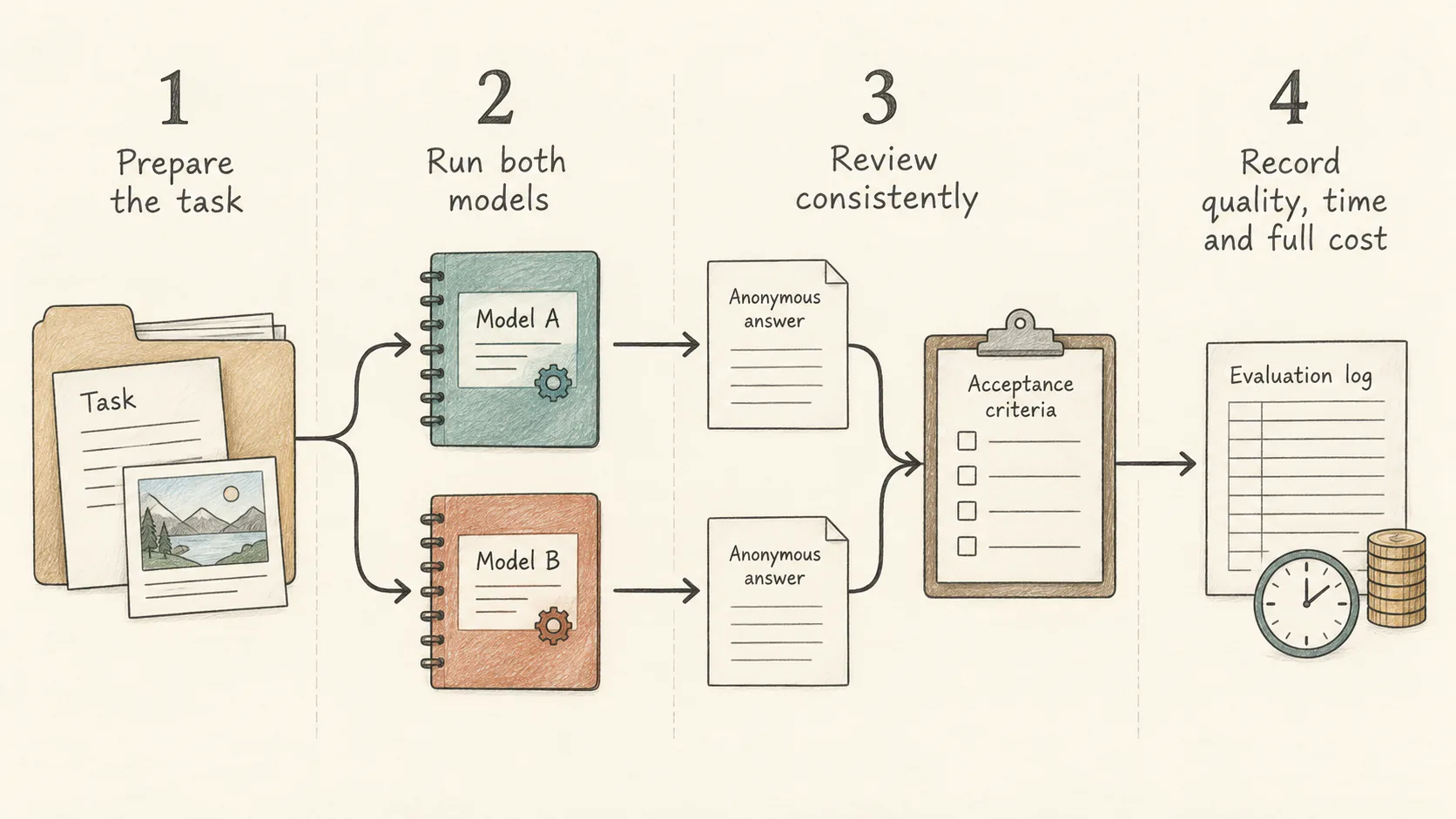
5. Make a comparison repeatable in four steps
Return to the login incident. First compare investigation plans based on supplied evidence. Separately compare actual repairs with repository access and tools. These stages need different permissions, context, and acceptance criteria.
- Freeze an evidence package. Give both models the same evidence for text and image tasks. For audio or video, record the whole native-input workflow and the alternative transcription or frame-extraction workflow.
- Define acceptance criteria. Does the answer separate facts from hypotheses, cite the evidence, and preserve important clues? For code changes, define checks and the permitted scope before running the task.
- Record the configuration and repeat runs. Save the model version, reasoning setting, tools, prompt, and output cap. A setting named max does not imply equal computation across models; also compare similar time or cost budgets.
- Review with model names hidden, then record full cost and human editing time. Keep failures and retries rather than selecting only the best result.
The following prompt is a starting point for the text-analysis stage.
Evidence: login page deployed at 10:02; at 10:05 Android users reported returning to the login page after signing in; desktop reproduction is not yet confirmed.
Task: separate known facts, hypotheses to verify, and next checks.
Requirement: identify the evidence for each conclusion; explicitly say when evidence is missing.
Constraint: do not present hypotheses as conclusions or claim that checks have already been executed.
This prompt fixes the supplied facts and the review focus. It checks restraint in reasoning. A repair task also needs code, a runtime environment, and executable acceptance conditions.
Another useful measure is cost per accepted task. The following two fictional aggregate examples demonstrate the calculation; they are not measurements of these models.
def cost_per_accepted(total_usd, accepted):
    return total_usd / accepted if accepted else float("inf")

print(cost_per_accepted(30, 60))  # 0.50 USD
print(cost_per_accepted(40, 90))  # about 0.44 USD
Total cost here should include model charges for failures and retries, plus actual tool or preprocessing charges. The second example spends more overall but costs less per accepted task. Track human review time separately so the tradeoff remains visible.
6. Prepare the Wonder side first
To prepare the Wonder side, you can use our Decisions API multimodal playground and check prices and limits on the dedicated model page. The complete key and API walkthrough is in Getting Started with Muse Wonder.
- Sign in, check your balance, and paste the text evidence from the preceding section.
- Start this short text task with a maximum output of 256. Increase the cap if the answer is truncated, and record the change in your evaluation log.
- After sending, retain the answer, usage, and actual charge. Run the same text task in your chosen Claude service.
This is the real interface with the case prepared, before sending.
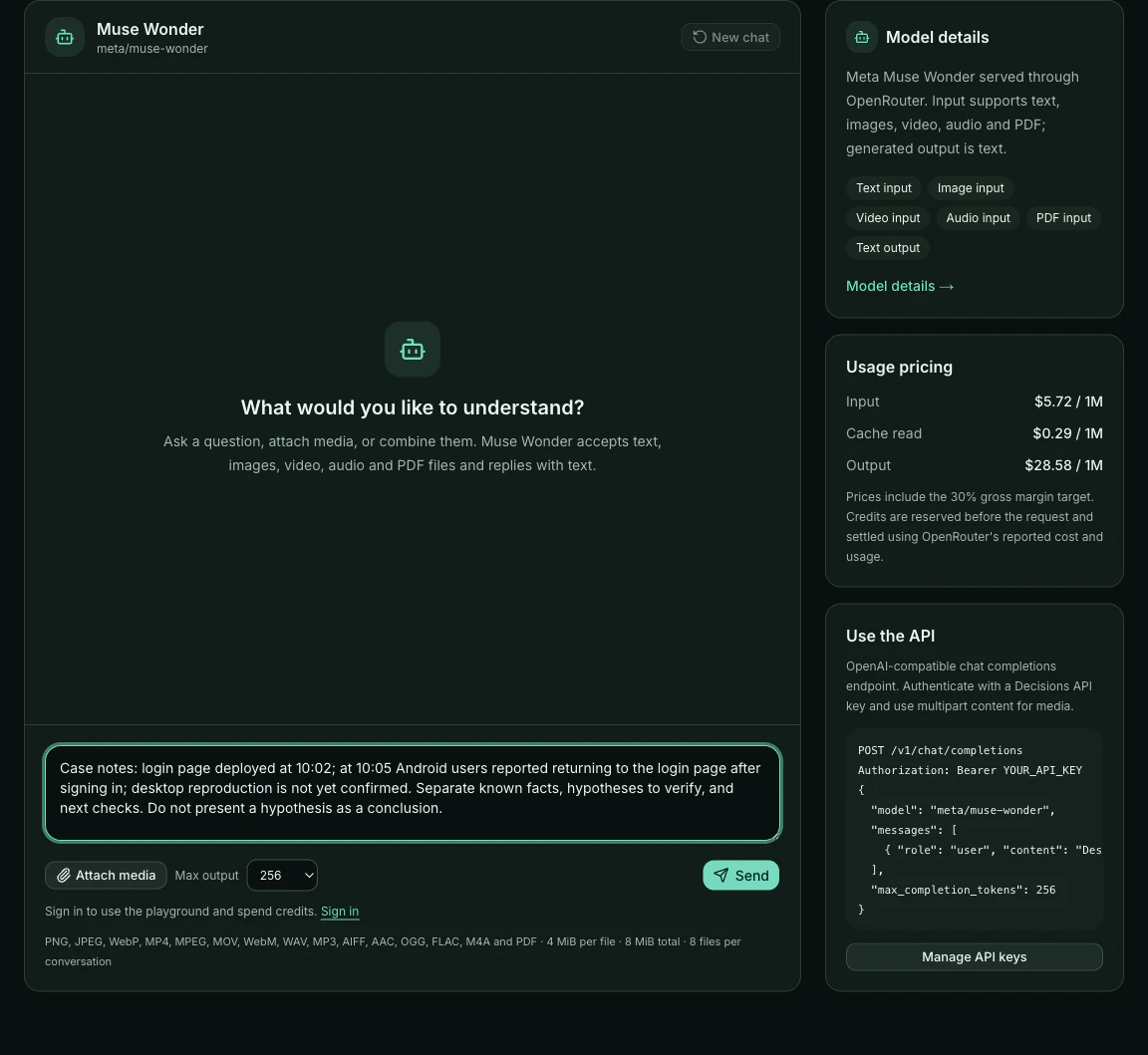
This chat endpoint currently serves meta/muse-wonder; Opus 5.5 requires a separate service. Displayed Wonder rates here are $5.72 input, $0.29 cache read, and $28.58 output per million tokens. Those are platform rates, distinct from the upstream base rates above.
The playground handles text and media chat. The current relay does not enable tool execution or an adjustable reasoning-effort parameter. This step therefore checks evidence comprehension and response quality. Reproducing a max-effort agent benchmark requires an endpoint with the relevant settings and tools.
7. Turn the choice into a workload decision
You can now make a practical decision table.
| Main workload | What to try first |
|---|---|
| General coding and knowledge analysis | Establish an Opus 5.5 quality and cost baseline |
| Longer software engineering tasks | Add Wonder to a shared-repository evaluation with the same acceptance criteria |
| Native video or audio understanding | Confirm Wonder’s service support, then compare the full Opus preprocessing workflow |
| Offline work that can wait | Calculate Opus Batch as a separate service mode |
| An established production workflow | Validate on a small sample before replacing the model or routing by task |
A model choice should leave an auditable record: what it read, what it got right, how long it took, and the total cost of producing the accepted result. Leaderboards narrow the candidate list. That record guides a product launch.
Further reading
This topic also draws on MyClaw’s comparison and Gabriel Anhaia’s analysis of Meta’s scorecard. Prices and scores in the article were checked against the relevant official sources or evaluation organization. These articles provide additional selection perspectives.